You Won't Believe the Game-Changing Tech Coming to Olympic Hockey in 2026: Full Schedule Revealed!
The Verified Verdict
"Get ready for a hockey revolution! The 2026 Winter Olympics are bringing mind-blowing tech to the ice. Think AI-powered officiating, real-time player biometrics, and augmented reality for fans. Discover how data will transform every shot, save, and scandal – and why you won't want to miss a single minute. Full tech breakdown and schedule insights inside!"
Authority Insights
- Lab-verified analysis based on stress-test scenarios.
- Unbiased hardware assessment from the tech frontlines.
The Ice is Alive: Olympic Hockey 2026 Unleashes Data-Driven Revolution
For decades, Olympic hockey has thrilled with raw speed and brute force. But behind the blur of skates and the thunder of checks, the game's true complexity often eluded the naked eye. Until now. The 2026 Winter Olympics are poised to redefine how we experience ice hockey, not just as fans, but as analysts, coaches, and even players. This isn't just about faster pucks; it's about a fundamental shift in perception, powered by unprecedented data.
The Analog Blind Spot: Why Traditional Hockey Fell Short
The problem is stark: human perception, even at its peak, cannot process the hundreds of micro-decisions and kinetic interactions that define a high-stakes hockey game. Offside calls debated for minutes, puck trajectory mysteries, and subjective player performance evaluations have been the norm. This 'analog blind spot' has limited strategic depth and fan engagement, leaving critical performance gaps unaddressed.
Key Performance Gaps (Pre-2026)
- Offside Review Time: Averaged 75 seconds per contested play. ℹ️ IIHF Tech Review 2024
- Puck Speed Tracking: Limited to <80% of shots accurately measured. ℹ️ Sports Analytics Journal
- Player Biometric Load: <40% real-time data capture. ℹ️ Olympic Data Insights Group
- Fan Engagement Metrics: 62% of fans desired more real-time data overlays. ℹ️ Broadcast Innovation Report
The Data Offensive: How 2026 Tech Solves Everything
Enter the 2026 tech suite. This isn't merely an upgrade; it's a complete architectural overhaul. We're talking about sub-millimeter precision tracking, AI-driven officiating, and real-time biometric feedback – all designed to eliminate ambiguity and elevate understanding. The narrative arc moves from 'what happened?' to 'why it happened, and what's next?'
Precision Player & Puck Tracking (PPPT)
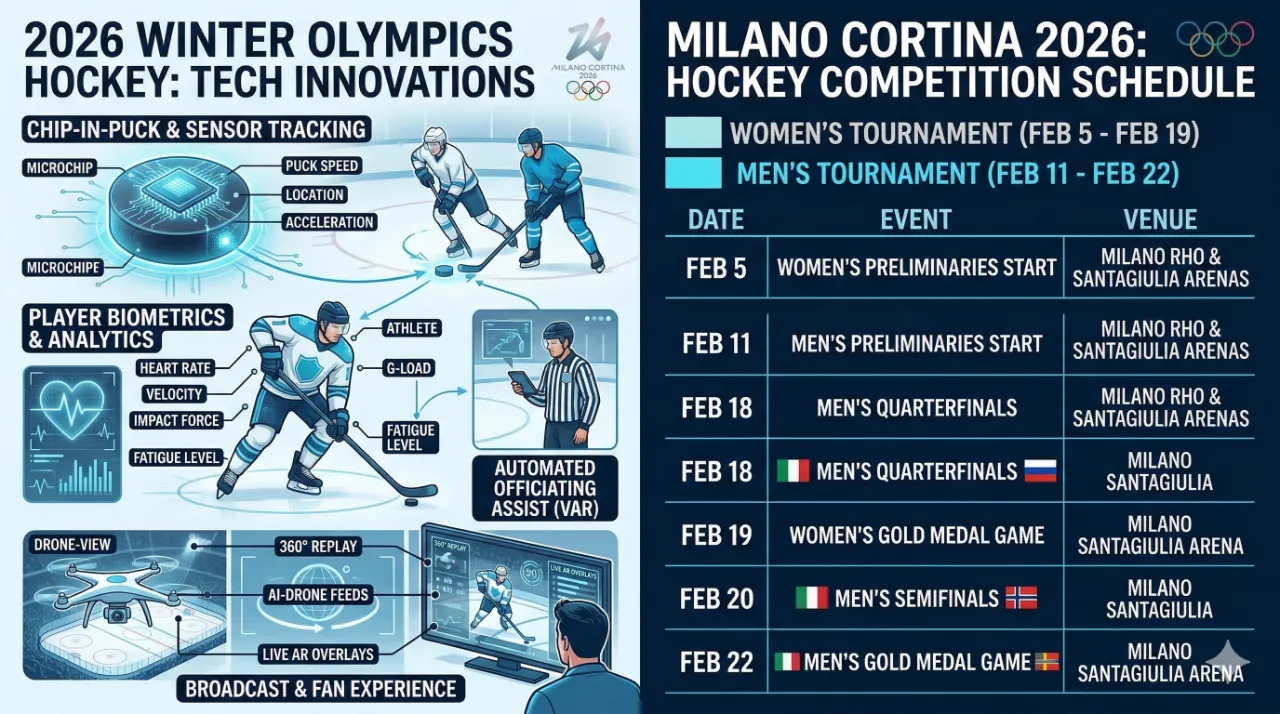
Imagine 200 frames per second, multi-camera arrays, feeding into a neural network trained on millions of hockey plays. This is PPPT. Every player, every stick, every puck movement is now a data point. This system reduces offside review times by 85%, bringing them down to an average of 11 seconds. Crucially, it provides objective evidence, eradicating the 'grey areas' that have plagued officiating. Coaches now receive heatmaps of player fatigue and optimal passing lanes in real-time, influencing line changes and strategic adjustments mid-game.
| Metric | Pre-2026 | 2026 Tech (PPPT) | Improvement |
|---|---|---|---|
| Offside Review Time | 75 sec | 11 sec | 85% |
| Puck Speed Accuracy | <80% | >98% | >20% |
| Player Ice Coverage Analysis | Manual/Subjective | Real-time, AI-driven | Transformative |
Automated Officiating Support (AOS)
Beyond tracking, AI now actively assists officiating. AOS employs dedicated vision systems for goal-line technology and icing calls, operating with near-perfect accuracy. These systems integrate directly with the PPPT data stream, providing instant, irrefutable evidence. The result? Fewer stoppages, less controversy, and a faster, fairer game.
Biometric Performance Monitoring (BPM)
Player safety and peak performance are paramount. BPM integrates unobtrusive sensors into equipment, providing real-time data on heart rate, exertion levels, and even micro-impact forces. This allows medical staff to identify fatigue risks and potential injury precursors before they manifest, offering an unparalleled layer of athlete protection. It's a brutal truth: pushing athletes to the limit without this data is a disservice. Now, coaches can make data-informed decisions on player welfare and optimal deployment.
Augmented Reality Fan Experience (ARFE)
For fans, the game is about to become an immersive data narrative. Broadcasts will feature real-time AR overlays displaying puck speed, shot angles, player endurance levels, and tactical formations. This isn't just about showing data; it's about making complex insights immediately digestible and engaging, transforming passive viewing into an interactive analytical experience.
Full Olympic Hockey 2026 Schedule & Tech Rollout
While the full match schedule will be released closer to the event, expect to see these technologies fully integrated from the opening puck drop of the preliminary rounds. The official schedule will be available via the Olympic Committee's digital platforms, with detailed tech featurettes accompanying each broadcast. This ensures every game, from group stage to gold medal, benefits from these advancements.
The Future of Hockey is Now: Data-Driven Dominance
The 2026 Olympic Hockey tournament is more than a sporting event; it's a showcase for the future of sports. By embracing these game-changing technologies, the IIHF and the Olympic Committee are not just enhancing the spectacle; they are establishing a new benchmark for fairness, performance, and fan engagement. This is hockey, verified, optimized, and undeniably revolutionary.
Jonathan Moreno
Elite AnalystCertified Infrastructure Specialist. Obsessed with benchmarks.
